Fees Against the Power Bill at 1,367 TH/s
Two costs dominate a mining room and only one of them is quoted as a percentage. At 1,367 TH/s the gross is $51.94 a day, the listed 4% on the block-reward component takes $2.08, and a 20 J/TH room at $0.06 per kWh burns about $39.37. The fee is the smaller number and the easier one to predict, which is exactly why it belongs on the same page as the meter reading.
Key takeaways
- 1,367 TH/s earns about 0.00061325 BTC a day, or $51.94 at the read-date price.
- The listed 4% on the block-reward component is $2.08 a day, while the listed 2% line is $1.04.
- A 20 J/TH room draws 27.34 kW, which is roughly 656 kWh and $39.37 a day at $0.06.
- After power and the listed 4%, about $10.49 a day remains at these inputs.
Two costs that move for different reasons
The pool fee changes when the rate card changes or when the mix of block reward and transaction fees shifts. The power bill changes when the room runs hotter, when a tariff step kicks in, or when a machine is swapped for one with a different efficiency. They rarely move together, which is why a single "cost per coin" figure hides more than it explains.
Keeping them apart has a practical payoff. If the net figure falls, you can say within a minute whether the cause was a rate change, a tariff change or a hardware change. If the two are merged into one blended cost, every movement looks the same and the response defaults to replacing hardware, which is the most expensive possible answer.
What the listed rate takes before the meter is read
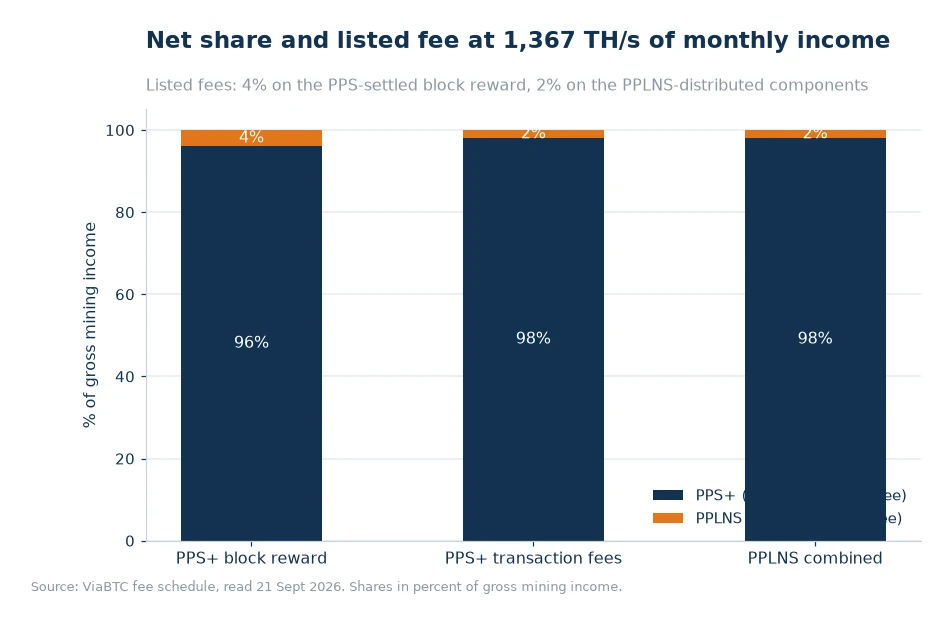
PPS+ is the default scheme and it applies a listed 4% to the PPS-settled block reward. The transaction-fee component is distributed on PPLNS logic and carries a listed 2%. Neither number is a surcharge on top of the credit; both are already removed when the hourly credit appears. So the $51.94 gross in the table is a reconstructed figure, and the amount that reaches the account is $49.86 after the 4% line.
PPLNS works differently and lands at a similar place for a different reason. It applies a listed 2% to block reward and fees combined, so on the same gross it takes $1.04 and leaves $50.90. The gap of $1.04 a day is the price of the hourly certainty that PPS+ provides, and at this size it is less than three days of one machine's power draw.
The panel arithmetic for a 1,367 TH/s room
Start at the breaker. A room of this size at 20 J/TH draws 27.34 kW, which is a comfortable single three-phase feed in most industrial units and a hard limit in a shed. At $0.06 per kWh that is 656.16 kWh a day and $39.37. Change the efficiency to 25 J/TH and the same hashrate draws 34.18 kW, costing $49.21 a day, which is more than the listed fee by a factor of twenty.
That comparison is the reason this article exists. Miners spend hours optimising a 4% line and almost no time checking whether their power contract has a demand charge that only bites above a threshold. The fee is visible and small; the tariff is invisible and large. Both deserve a line in the same spreadsheet.
Panel readings also settle arguments that specs cannot. Two machines with the same nominal hashrate but different efficiency will show up on the clamp meter within a day, and the worse one is not always the older one. Measure at the feed, subtract the lighting and cooling load, and divide by the number of machines actually hashing. Anything that does not match the label is worth investigating before the next hardware order.
Why the fee is the predictable half
Within a month, the listed rate is the only cost that does not surprise you. It applies to a component you can estimate from hashrate and difficulty, and it does not care about ambient temperature, tariff windows or whether the utility changed its billing cycle. That predictability is useful even when the amount is small, because it gives you a fixed point against which the volatile costs can be measured.
It also makes the fee easy to budget. At $2.08 a day the monthly figure is $62.32, and that number changes only if the hashrate, the difficulty or the rate card changes. Power, by contrast, can move 15% between a mild month and a hot one without any change in production. Budget the fee once and revisit the power line every month.
The ViaBTC Pool Fees schedule is short enough to read in full, and reading it once explains why the 4% and 2% lines sit on different bases. Do that before the first invoice arrives rather than after, because a page of percentages is much easier to absorb when there is no money to argue about yet.
A bill-shaped table
The table puts the pool deduction and the power estimate in the same units so the comparison is immediate.
| Cost line | Per day | Per 30 days | What moves it |
|---|---|---|---|
| Gross mining income | $51.94 | $1,558.12 | Hashrate, difficulty, BTC price |
| Listed 4% on block reward | $2.08 | $62.32 | Rate card, block-reward share |
| Listed 2% on PPLNS components | $1.04 | $31.16 | Rate card, fee share |
| Power at 27.34 kW | $39.37 | $1,181.09 | Tariff, efficiency, runtime |
Read the last two rows together. Power is roughly nineteen times the listed 4% line at these inputs, yet the fee is the line most operators can quote from memory. That imbalance is a habit problem, not an information problem.
Worked example: from breaker rating to net coin
Follow one day from hashrate through the fee and the meter to what is left.
- Per terahash: 450 ÷ 1,003,000,000 = 0.00000044865 BTC a day.
- The room has 1,367 of them, so 0.00061325 BTC a day.
- Multiply by $84,692 for a gross of $51.94.
- Four percent of that gross is $2.08, the block-reward deduction.
- Two percent is $1.04, the PPLNS-distributed figure.
- At 20 J/TH the load is 1,367 × 20 = 27,340 W.
- Over 24 hours that is 656.16 kWh; at $0.06 the bill is $39.37.
- Subtract both from gross: 51.94 − 2.08 − 39.37 = $10.49 a day.
A tariff rise from $0.06 to $0.07 would add $10.93 a day to the power line and turn that margin negative. That is the sensitivity worth testing before signing a power contract, not the fourth decimal of a fee percentage.
Frequently asked questions
Is the pool fee or the power bill bigger at 1,367 TH/s?
Power is far bigger at these inputs: $39.37 a day against $2.08 for the listed 4% line, so a tariff change moves the result roughly nineteen times as much as the fee.
What efficiency assumption does the power figure use?
Twenty joules per terahash, which gives 27.34 kW at 1,367 TH/s; at 25 J/TH the same hashrate draws 34.18 kW and costs $49.21 a day at $0.06.
Does the listed 2% apply to the whole gross?
No, the listed 2% applies to the PPLNS-distributed components, which are the transaction fees under PPS+ and both components under a PPLNS account; the figure here is what it would take if the whole gross sat on that base.
Read both numbers on the same evening
Pick one evening a month and read the meter and the credit history within an hour of each other. Write the fee, the kWh and the net on one line. After three months the pattern is obvious and the arguments about which cost is out of control stop. For hosting or site options, the Mining Farms listing shows what a managed room provides, and the pool state page confirms the operational side before you commit a breaker to a new load.
Rates from the ViaBTC fee schedule[1]; market figures read 21 Sept 2026 (BTC $84,692, 1,003 EH/s, difficulty 132.76 T, 450 BTC a day from 144 blocks of 3.125 BTC). The 20 J/TH efficiency and $0.06 tariff are assumptions for illustration, not quotations. Published 24 Oct 2026.