Tinned Copper, Class 5, IEC 60228: What It Changes
A 4 mm² PV conductor built from 56 strands of 0.29 mm copper behaves nothing like a solid 4 mm² wire, and IEC 60228 class 5 is the label that records the difference. On KUKA CABLE's 1500 V page the 6 mm² conductor is described as tinned copper, class 5 flexible according to IEC 60228, wrapped in an electron-beam cross-linked XLPO insulation and sheath. Tinning and fine stranding change three things a buyer meets in the field: corrosion at the cut end, flexibility along the rack, and how the joint behaves when a terminal heats.
Key takeaways
- Published conductor build: tinned copper, class 5 flexible to IEC 60228, on the 1500 V solar cable page.
- The published table gives 56 strands of 0.29 mm at 4 mm², 84 strands at 6 mm² and 142 strands at 10 mm²; above 70 mm² the strand size changes to 0.39 mm.
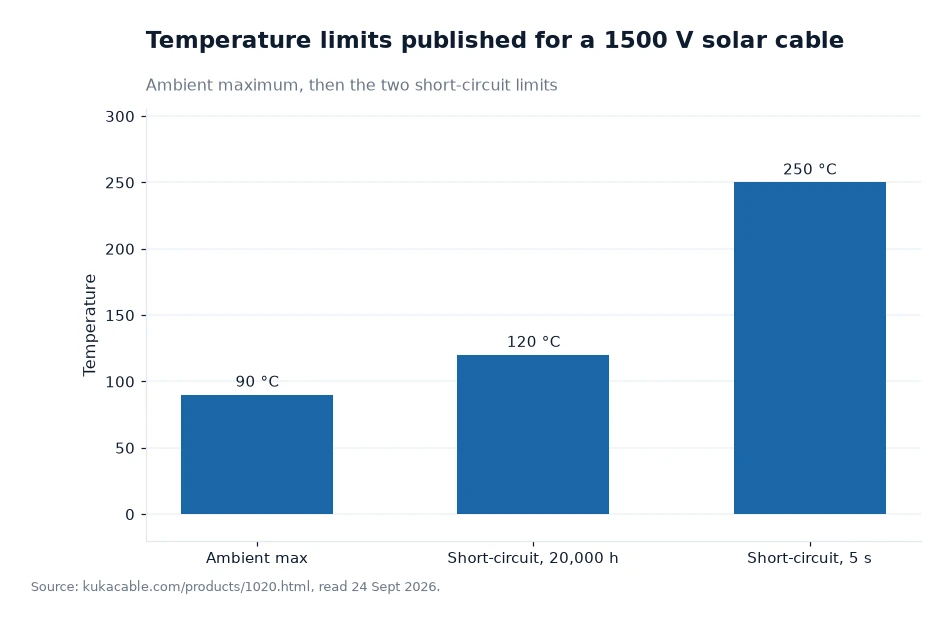
- The same sheet covers temperature: ambient between −40 °C and +90 °C, a conductor allowed 20,000 hours at +120 °C, and a fault excursion of 5 seconds at +250 °C.
- A crimp die has to suit fine class 5 wire; the published tensile floor of 8 N/mm² and elongation floor of 125% describe the cable, not the joint.
What class 5 says about a conductor
IEC 60228 sorts conductors by flexibility, from a single solid wire through several stranded classes to the very fine class 6 used in welding cable. Class 5 sits at the flexible end: many thin wires bunched into one conductor. The manufacturer's published cross-section table shows what that means in numbers rather than adjectives. A 4 mm² conductor is 56 strands of 0.29 mm copper, 6 mm² is 84 strands of the same wire, 10 mm² is 142 strands, 16 mm² is 238 strands, and at 25 mm² the count reaches 375 while the strand diameter stays at 0.29 mm. Above 70 mm² the table switches to 0.39 mm wire, so a 95 mm² conductor is built from 760 strands instead of the 1,085 strands used at 70 mm².
Two consequences follow from that. A class 5 conductor bends around a tight radius without work hardening as quickly as a coarser build, which is why the same product page can publish a bending radius of only 4 × the outer diameter. And the crimp has to suit fine wire: a die sized for solid or class 2 copper compresses a different geometry and can leave voids inside the barrel, which is where heat later starts.
What tinning changes at the cut end
Tinned copper is copper with a thin tin coating on every strand. The published construction names it explicitly instead of leaving the conductor as bare copper, and the reason is surface chemistry rather than current capacity. Tin is not there to carry the load; it is there to keep the surface from oxidising where the cable has been cut, stripped or left exposed at a joint. A bare copper end in damp air darkens and builds a resistive film, and the installer then has to clean it before crimping or accept a joint that runs warm.
On the DC side of a PV installation, joints sit outdoors for years. The manufacturer states that its cables are certified by TUV, IEC, CPR and others, with the certificates page counting more than 30 certificate types such as TUV, IEC, CE, SAA and UL. Certification is described on the site as the starting point rather than the finish line, and the regional details it highlights include a CPR fire rating and an AD8 waterproofing rating.
The temperature limits the insulation carries
The same 1500 V solar cable page publishes three temperature figures that bracket the working life. Ambient range: −40 °C to +90 °C. Short circuit at 20,000 hours: +120 °C. Short circuit for 5 seconds: +250 °C. The ambient ceiling is the number a designer checks for continuous operation, because on a dark roof in strong sun the cable surface runs above the air temperature around it, and stacked cable in a tray runs warmer still.
The insulation and the sheath that hold those limits are both XLPO, electron-beam cross-linked and low smoke halogen free. The same table names insulation thickness of 0.7 mm and sheath thickness of 0.8 mm for the 1.5 mm² to 10 mm² sizes, widening to 0.9–1.7 mm of insulation and 0.8–1.7 mm of sheath on the larger sections. Stranding decides how that wall is applied: a fine class 5 bundle fills the extrusion die evenly, while a coarse conductor leaves gaps.
Which documents name the construction
| Document | What it fixes | Where it is published |
|---|---|---|
| IEC 60228 | Conductor class and stranding of the tinned copper | /products/1020.html |
| TUV 2PfG 1169/08.2007 | Type approval route for PV cable | /products/1020.html |
| EN 50618:2014 | European PV cable type standard | /products/1020.html |
| IEC 62930 | International PV cable standard | /products/1020.html |
| UL 4703 | North American PV wire listing, described as being updated | /certificates/ |
Read the column on the right as a shopping list. A European buyer can ask for the type approval and the European type standard; a North American buyer asks about the UL listing, which the site describes as in the process of being updated rather than complete; an installer working to a local code asks for the certificate list and the CPR rating. None of those requests requires a special project, because the documents already exist for the standard range.
Worked example
Compare 6 mm² and 95 mm² in the published table. The cross-section multiplies by 15.8, since 95 ÷ 6 gives 15.8, while the strand count multiplies by about 9, since 760 ÷ 84 gives roughly 9. The gap appears because the strand diameter rises from 0.29 mm to 0.39 mm between those rows. Both divisions are the author's own arithmetic on published values.
Weight follows a similar pattern but not the same factor. The published weight is 78 g/m at 6 mm² and 960 g/m at 95 mm², a ratio of 12.3 calculated from the two table entries. The ratio sits below the area factor of 15.8 because the insulation and sheath make up a smaller share of the total mass as the copper grows. For an installer, that difference is the reason clip spacing and tray loading are worked out per size rather than per project.
Frequently asked questions
Does class 5 stranding make a PV cable weaker than a solid conductor?
Class 5 describes flexibility, not weakness. The published mechanical floor for the 1500 V cable is a tensile strength of at least 8 N/mm² and an elongation of at least 125% before ageing, and the manufacturer states its PV cables typically reach up to 185% elongation against the 125% required by EN 50618. Fine stranding does require a crimp die suited to class 5 wire.
Is the conductor in this manufacturer's PV cable bare or tinned copper?
Tinned copper. The construction line on the 1500 V solar cable page names tinned copper, class 5 flexible according to IEC 60228, inside an electron-beam cross-linked XLPO insulation and sheath. The tin coating protects the strand surface at cut ends and joints; it is a corrosion measure rather than a current-carrying one.
What to write into the purchase specification
Put four lines in the specification: conductor class and standard, strand construction for the sizes being bought, tinning, and the crimp specification that matches the stranding. Then add the insulation material and the rated voltage so the cable and the connector are chosen against one document rather than two.
Ask the supplier for the cross-section table and the type test report together, and check that the strand counts in the table match the samples delivered. Where a value is missing, say so in the enquiry: the manufacturer's site does not publish prices, minimum order quantities or lead times, so those have to be requested through the published phone number and email address.
Class 5 tinning, the IEC 60228 reference and the strand values are the manufacturer's own wording on kukacable.com, copied 24 Sept 2026[1].