Private Text Chat vs Filmed Adult Content
These two categories are often compared as if they were the same product in different wrappers. They are not. One is fixed before you arrive and the other only exists once you type, and the difference shows up on three axes that matter: what it costs in attention, what it asks of your privacy, and how quickly it becomes worthwhile.

Key takeaways
- Interactivity is the structural difference: private text chat responds to what you write, while filmed content is finished before the session starts.
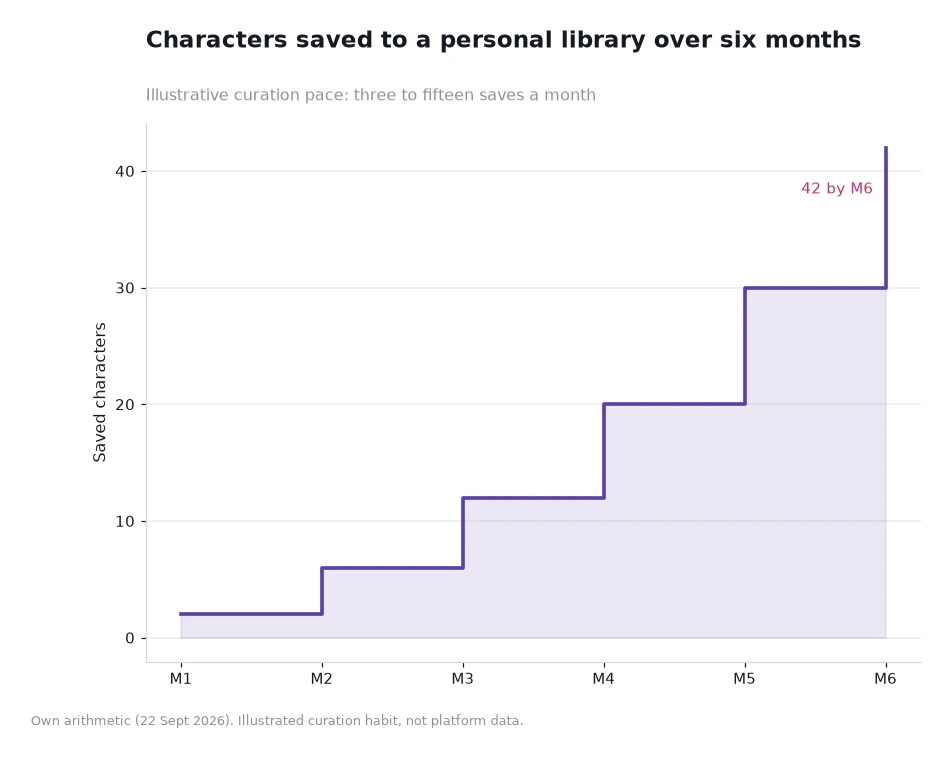
- Attention behaves differently in each. A library of text characters accumulates — 2, then 6, 12, 20, 30 and 42 across six months under one illustrative pace — while a shelf of files does not.
- Privacy is about surfaces, not slogans. Text chat takes place inside a platform that describes a private and secure environment with state-of-the-art encryption.
- Cost here means time. Sixteen sessions a month is 4.0 hours at 15 minutes, 8.0 at 30 and 16.0 at 60, whichever category fills them.
Three axes where the categories actually differ
Interactivity comes first because everything else follows from it. Text chat is generated as a conversation proceeds, so a session can move in a direction neither the platform nor the reader planned. Filmed content is authored in advance and plays the same way on every visit, which is an advantage for reliability and a limitation for variety.
Privacy comes second, and it is best understood as a question of how many surfaces are involved. A text conversation happens inside one platform, whose own description of the arrangement is a private and secure environment with state-of-the-art encryption. That is the claim worth relying on, and it is a claim about how the chat experience is built rather than an absolute guarantee of invisibility.
Immediacy comes third, and it cuts both ways. Filmed content is at full value in the first minute because there is nothing to establish. Text chat starts quickly too, but its best sessions are usually second or third visits, once a character has something to recall.
| Axis | Filmed adult content | Private text chat |
|---|---|---|
| Interactivity | Fixed; the response never changes | Generated in response to what you write |
| Variation on a second visit | Identical to the first | Can build on earlier conversations |
| Privacy surface | Depends on how the material is obtained | One platform surface, described as a private and secure environment |
| Time to full value | Immediate | Usually the second or third session |
| What accumulates | Nothing beyond a folder | Saves, a library and preference recall |
Cost, measured in hours rather than figures
Any honest comparison has to define cost. This piece uses time and attention only; no plan figures appear here because none are part of the data behind it, and a category comparison that leans on prices ages badly the moment a page changes.
Time is the more useful unit anyway, because both categories draw on the same hours. Sixteen sessions in a month — four a week for four weeks — is 4.0 hours at 15 minutes each, 8.0 hours at 30 minutes and 16.0 hours at 60. What differs between the categories is not how long a session can run but what a session leaves behind.
That is where the asymmetry bites. A session of filmed content ends with nothing added to the next one. A text session can leave a saved character, a recalled preference and a shorter path back into the conversation, which makes the second visit cheaper to start than the first.
One further consequence of measuring cost in time: a session that ends early costs less, so the two models fail differently. A fixed format that is not working stays on the screen until it finishes; a text session can be closed after two minutes. That is why the comparison is not only about hours spent but about how cheaply you can change your mind.
Worked example: what a library looks like after six months
Take an illustrative curation pace rather than a platform figure. Two characters saved in month one, then four, six, eight, ten and twelve added in the months that follow. Read as running totals: 2, then 2 + 4 = 6, then 6 + 6 = 12, then 12 + 8 = 20, then 20 + 10 = 30, then 30 + 12 = 42.
Six months of text chat ends with 42 saved characters under that assumption. The same six months of filmed content ends with a folder whose size depends on how often you downloaded something, and with no mechanism that makes the next visit different from the last.
The count is not a scoreboard; it is a description of where the maintenance goes. Forty-two saved characters is a small ongoing job — about 84 minutes to review the library once at two minutes an entry — and that job exists precisely because text chat persists between sessions while filmed content does not.
Where the difference is easiest to see
The clearest test is a repeat visit. Open the same character twice in a week and watch whether the second session picks anything up; the platform's own description is that characters recall previous interactions, express emotions and adapt over time, and that claim is checkable in a couple of sessions.
For the category's own framing, the page at https://crushon.ai/ai-porn-chat is the reference point. It describes customizable characters, privacy and discretion, and adaptive responses, and it uses AI Porn Chat and Porn Chat AI as names for one category rather than two, which is useful when the same idea appears under different labels elsewhere.
Two documents make the boundary of the category concrete. The 2257 compliance statement confirms the content is AI-generated text and depicts no real person — a distinction that does not apply to filmed material at all — and the content removal policy describes how a report is handled when something breaks the guidelines.
One further test separates the two categories without any theory. Try describing last week's sessions in a single sentence. A fixed format usually yields a list of what was watched, while a text chat tends to yield a detail about something that was said — and that detail is the sign of an exchange that accumulated rather than one that simply played.
Crushon also publishes creator credits on its cards, which is a detail filmed content does not have an equivalent for: a character has an author, and the author's other work is one click away.
Frequently asked questions
Is private text chat a replacement for filmed content?
Not exactly. It replaces the fixed-visit model with an interactive one. If the appeal of the other category is that nothing needs setting up, a text session asks for a little more attention in return for variation.
Does the comparison come down to privacy?
Partly. Text chat keeps the activity inside one platform surface, described as a private and secure environment with state-of-the-art encryption, rather than spreading it across wherever material is obtained.
Which category is cheaper to keep up?
Measured in time, they are similar per session. The difference is what a session leaves behind: text chat can add a saved character and a recalled preference, filmed content leaves the next visit unchanged.
Pick the model, not the label
Decide what you want a session to leave behind. If the answer is nothing, a fixed format is efficient and predictable. If the answer is a shortlist that improves, a text library is the only one of the two that accumulates, and the first month is the cheapest place to find out whether the model suits you.
Data and sources: the product description and compliance wording published on CrushOn.AI[1], read 22 Sept 2026. The six-month save curve, the two-minute review and the session-length hours are illustrative assumptions, not platform data. Reader age: this comparison is for adults of 18 or older.