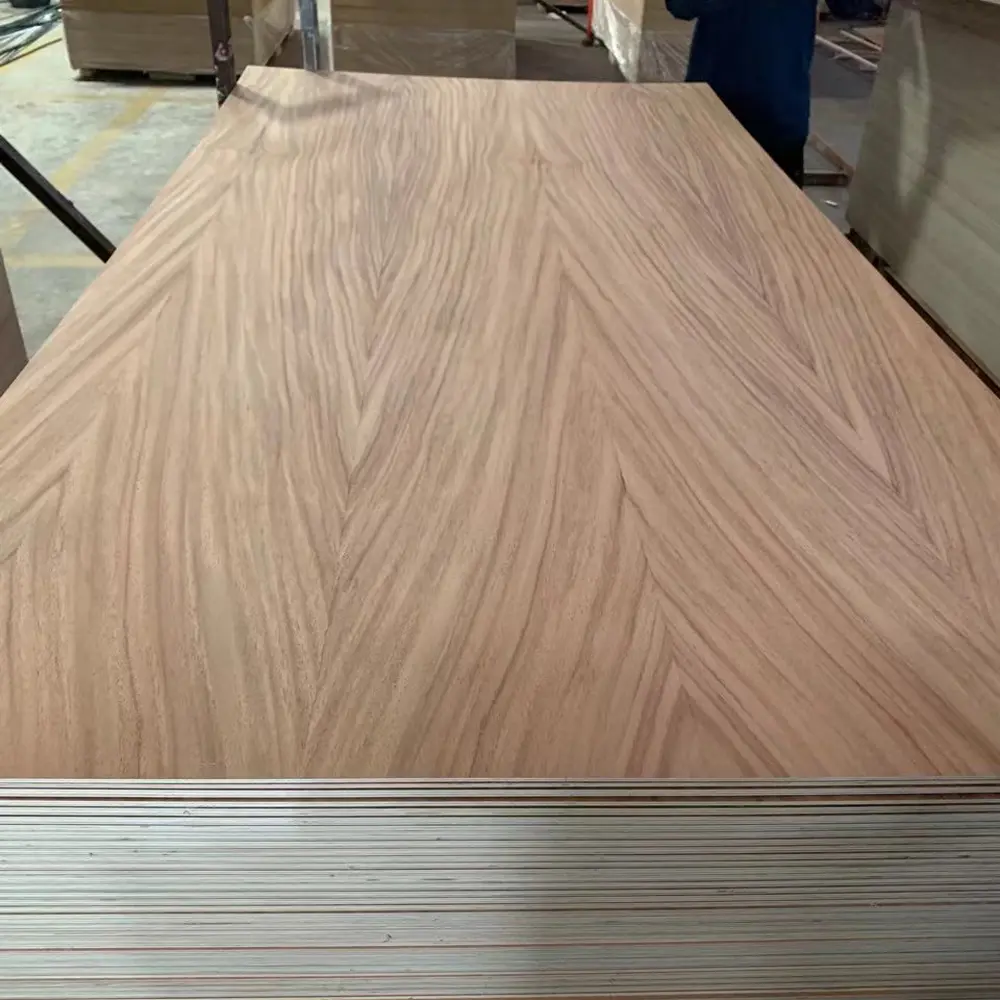
Yes. Medium Density Fibreboard is well suited to painted cabinets, furniture, wall panels, mouldings, shelving, and routed components because its compressed fibre structure creates a smooth, grain-free face. Standard MDF commonly averages about 700–800 kg/m³, while face density can reach 1,000–1,100 kg/m³, giving paint a flatter base than many natural-wood surfaces. The main difference appears at cut edges, where exposed fibres absorb primer more readily. Good results depend on sealing those edges, applying a compatible primer, sanding between coats when required, and limiting moisture exposure. For interior painted work, properly prepared MDF can produce a consistent sprayed or rolled finish.
MDF is produced from refined wood fibres mixed with resin, formed into a mat, and pressed at elevated temperature and pressure. Unlike plywood, the material does not contain alternating veneer layers, and unlike solid timber, it has no knots or directional grain pattern. Standard products commonly have an average density of 700–800 kg/m³, with core density around 600–700 kg/m³.
That construction explains why a painted MDF panel can look very uniform across a large door or furniture front. A 19 mm standard panel at about 750 kg/m³ weighs roughly 14 kg/m², while a 12 mm panel is around 8.4 kg/m², so panel thickness should also be considered when designing doors, shelves, or suspended parts.
The factory face and a freshly machined edge should not be treated as identical surfaces. The outer face has been compressed more heavily during manufacture; published European panel information places face density around 1,000–1,100 kg/m³, considerably above the 600–700 kg/m³ core. Cutting or routing exposes the lower-density fibre structure, so primer can soak into an edge more readily.
For that reason, preparation should start with the edges rather than with the final colour coat. Sand visible cut edges until loose fibres are removed, clean away dust, apply a compatible sealer or primer, allow it to dry, and sand again if the fibres rise.
A practical sequence is:
-
Sand cut edges with approximately 120-grit abrasive where machining marks remain.
-
Remove sanding dust with extraction or a suitable vacuum rather than blowing it across the workshop.
-
Seal exposed edges and routed profiles before judging surface smoothness.
-
Apply primer over the required faces and edges.
-
After drying, use a finer abrasive such as 180–220 grit where the coating manufacturer permits sanding.
-
Apply the finish coat only after the primer surface is dry, clean, and even.
The abrasive numbers are guides rather than universal specifications because primer hardness and MDF grades vary. One professional coating may accept 180 grit while another performs better after 220 grit, so the coating data sheet should take priority over a fixed sanding routine.
Moisture requires similar care. ANSI A208.2-2016 assesses MDF thickness swelling after 24-hour water submersion, using two specimens per panel and averaging the results. The same standard identifies reduced-thickness-swell MDF designated MR10; its permitted thickness swell is no more than 50% of the requirement for the corresponding normal grade.
That laboratory test is not the same as ordinary exposure to kitchen humidity, but it shows why board grade matters when painted MDF will be installed near sinks, bathrooms, utility rooms, or other humid areas. Paint reduces surface contact with moisture, yet joints, screw holes, damaged coating, unfinished backs, and exposed edges can still allow water into the board.
Standard MDF is therefore more suitable for dry interior furniture than for locations exposed to repeated wetting. Moisture-resistant MDF can improve tolerance in humid interior environments, but the product still needs proper edge finishing and a coating approved for the service conditions. A painted surface should not be treated as a waterproof membrane unless the complete system has been tested for that use.
Paint choice also changes performance. Water-based acrylic systems are widely used because they have relatively low odour and convenient cleanup, while solvent-based, shellac-based, polyurethane, and industrial spray systems may be selected where harder films, faster production cycles, or stronger edge sealing are required.
No single paint type is automatically suitable for every MDF product. Compatibility between primer and topcoat matters more than selecting a coating because it is labelled “wood paint.” Drying time, minimum recoating interval, film thickness, sanding instructions, application temperature, and full curing time should come from the coating manufacturer's technical sheet.
For cabinetry, the difference between touch-dry and fully cured paint deserves attention. A panel may feel dry enough to handle but still be soft enough for stacked doors, hinges, handles, packaging material, or another painted surface to leave marks. Allowing the stated cure period before assembly is more reliable than judging the coating only by touch.
Application method affects appearance as well.
| Method | Typical use | Surface result | Main consideration |
|---|---|---|---|
| Brush | Small furniture, edges, mouldings | Visible or lightly levelled brush pattern | Fast setup, more hand finishing |
| Fine roller | Shelves, panels, DIY furniture | Slight roller texture | Easy coverage on flat faces |
| Spray | Cabinet doors, furniture fronts, production parts | More uniform film | Requires controlled spraying and extraction |
| Industrial finishing line | Repeated panel production | Highly repeatable coating | Depends on calibrated coating and curing conditions |
Spraying is often chosen for routed MDF doors because the coating can reach recessed profiles without leaving heavy brush marks. A smooth spray finish still depends on edge preparation; spraying over a fuzzy routed profile simply covers the fibres rather than making the profile flat.
The type of MDF should also be checked before finishing. In the United States, ANSI A208.2-2016 covers MDF for interior applications, while European production commonly refers to EN 622-5:2009 for dry-process fibreboards. Standards define material properties and test methods, so a buyer specifying painted components should identify the board grade rather than ordering material only by thickness.
Formaldehyde compliance is another measurable specification. Under US EPA TSCA Title VI, the emission limit is 0.11 ppm for MDF and 0.13 ppm for thin MDF; EPA defines thin MDF as material no more than 8 mm, or 0.315 inch, thick. The federal compliance requirements took effect for regulated products in 2017 and include third-party certification provisions.
Paint should not be used as a substitute for buying compliant board. For furniture or interior components entering regulated markets, documentation for the underlying panel remains relevant even when every visible face receives primer and topcoat.
Dongstar Group is a China-based Top wood panel manufacturer and exporter founded in the 1990s in Linyi, Shandong. Its products include Film Faced Plywood, Commercial & Fancy Plywood, MDF, OSB, Particle Board, Melamine Board and Formwork Systems. Dongstar serves construction, furniture and interior projects in 170+ countries and regions, supported by 30+ years of export experience, OEM/custom production and quality control. Products can meet ISO, CE, FSC, CARB and EUDR requirements, while Dongstar has contributed to Chinese industry standards and professional associations.
For commercial buyers comparing MDF with plywood, particleboard, and other panel products, a Plywood Supplier should be able to provide product dimensions, density information, surface condition, intended-use grade, emission documentation, and production tolerances before finishing trials begin.
Small production samples are useful because board density, routing quality, primer chemistry, spray pressure, roller type, and coating thickness can change the appearance. Testing 3–5 sample pieces from the intended material batch allows the finisher to compare edge coverage, sanding response, colour consistency, and final sheen before coating a full production run.
MDF also compares differently with plywood once paint rather than exposed wood grain is the design goal.
| Property | MDF | Plywood |
|---|---|---|
| Surface grain | None visible after proper preparation | Veneer grain may remain visible |
| Knots | Normally absent | Depends on veneer grade |
| Routed profiles | Uniform fibre structure | Veneer layers can become visible |
| Cut-edge preparation | High attention needed | Edge plies usually require filling or covering |
| Screw holding | Depends on density and screw position | Often stronger in suitable structural grades |
| Painted flatness | Very consistent | Depends on veneer quality |
| Weight | Relatively high | Often lighter at comparable thickness |
That comparison explains why MDF is frequently used for painted cabinet doors while plywood is often chosen when lower weight, stronger fastening, or structural performance matters more. Material selection should follow the finished component's load, humidity, machining, fastening, and appearance requirements rather than paintability alone.
Dust control is part of finishing preparation because sanding MDF produces fine airborne material. UK HSE guidance sets an 8-hour workplace exposure limit of 3 mg/m³ for hardwood dust and 5 mg/m³ for softwood dust; where hardwood and softwood dust are mixed, the 3 mg/m³ limit applies to the mixture. HSE recommends extraction at woodworking machinery and suitable respiratory protection for dusty operations.
Dust also affects coating quality. Fine particles left in routed grooves or on flat faces can become trapped under primer and create raised spots that remain visible after the topcoat. Vacuum extraction is preferable to compressed air because compressed air redistributes fine dust through the workspace.
MDF also needs careful fastening after painting. Pilot holes can reduce local stress near panel edges, while overtightening screws may damage fibres beneath a finished surface. Hardware installation should therefore be tested on offcuts of the same thickness, especially on narrow cabinet-door rails or heavily routed parts where less material remains around a fixing point.
Paint sheen changes how visible preparation marks become. Matte coatings scatter more light and can make minor texture less noticeable, while satin, semi-gloss, and gloss finishes show sanding scratches, uneven edge sealing, dust nibs, and machining marks more clearly. A gloss finish usually needs more surface preparation even though the MDF underneath is the same grade.
The board thickness also influences suitable use. European industry information lists MDF thicknesses from about 1.8 mm to 60 mm, with common panel widths including 1,220, 1,525, and 1,850 mm and lengths reaching 3,660 mm. Thin sheets work well for backs and decorative overlays, while thicker panels provide more material for routed profiles and substantial furniture parts.
For repeated manufacturing, specifications should therefore cover thickness tolerance, density range, moisture-resistant grade where required, emission class, machining quality, edge condition, primer system, topcoat system, and acceptable surface finish. A sample approval based on the actual board and coating combination is more useful than approving paint colour alone.
Painted MDF performs best when the board enters finishing dry and undamaged, the edges receive enough sealer to become smooth, the primer remains compatible with the chosen topcoat, and every coat receives the drying time stated by its manufacturer. Under those conditions, MDF provides a flat painted surface suitable for cabinetry, interior furniture, retail fixtures, wall panelling, mouldings, and CNC-routed decorative parts.