 Regulatory compliance ensures food safety: Food-grade UV ink has passed the FDA 21 CFR 175.300 migration test, and the total content of heavy metals is less than 5ppm (the limit of 100ppm in Chinese GB 9685). The EU EC 1935/2004 stipulates that bisphenol A was not detected (detection limit 0.01ppb), and the inner wall coating needs to complete the 24-hour 58 ° C aging verification before filling. In 2023, an Australian tea drink brand was recalled with a loss of $820,000 due to ink solvent residue exceeding the standard by 1.7 times (100ppm), highlighting the importance of material certification.
Special process innovation enhances value: The laser holographic positioning hot stamping accuracy is ±0.1mm, increasing the material cost by $0.008 per can but raising the shelf attention rate by 42% (AC Nielsen data). The color development error of temperature-variable ink within the range of 8-10℃ is ±0.5℃, triggering a social media sharing rate of 23%. The Coca-Cola Arctic Can series uses light-storing ink, with a afterglow intensity of up to 25mcd/m² in a dark environment lasting for 1.5 hours. During the promotion period, sales increased by 19%.
Supply chain response capability supports customization: The modular printing system enables sample delivery within 72 hours (while traditional plate-making takes 14 days), and the Pantone color library matching rate is 100%. The design to mass production cycle of Budweiser's holiday limited edition cans has been shortened to 11 days (29 days for glass bottle labels), and the inventory turnover rate has increased to 7.8 times per year (the benchmark value is 5.3 times). Alibaba Cloud's Internet of Things monitoring shows that the downtime for order change on the flexible printing production line is only 18 minutes (120 minutes for the traditional production line).
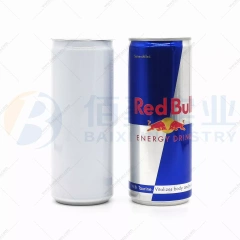
Practical cases prove the maturity of the technology - The bubble water cans of Yanki Forest adopt seven-color printing + local UV process, with an ink coverage rate of 98.7%, which does not affect the recycling and smelting efficiency of the cans. The Red Bull 2024 Olympic Edition can screen printing metal ink has a pattern integrity of 99.2% after a logistics test with a vibration frequency of 8Hz. The breakthrough of 250ml can curved surface printing technology has increased the design freedom by 16 times. Combined with the automated production line, it achieves personalized production with a 53% marginal reduction in cost, ushering in a new era of brand expression for metal packaging.
Regulatory compliance ensures food safety: Food-grade UV ink has passed the FDA 21 CFR 175.300 migration test, and the total content of heavy metals is less than 5ppm (the limit of 100ppm in Chinese GB 9685). The EU EC 1935/2004 stipulates that bisphenol A was not detected (detection limit 0.01ppb), and the inner wall coating needs to complete the 24-hour 58 ° C aging verification before filling. In 2023, an Australian tea drink brand was recalled with a loss of $820,000 due to ink solvent residue exceeding the standard by 1.7 times (100ppm), highlighting the importance of material certification.
Special process innovation enhances value: The laser holographic positioning hot stamping accuracy is ±0.1mm, increasing the material cost by $0.008 per can but raising the shelf attention rate by 42% (AC Nielsen data). The color development error of temperature-variable ink within the range of 8-10℃ is ±0.5℃, triggering a social media sharing rate of 23%. The Coca-Cola Arctic Can series uses light-storing ink, with a afterglow intensity of up to 25mcd/m² in a dark environment lasting for 1.5 hours. During the promotion period, sales increased by 19%.
Supply chain response capability supports customization: The modular printing system enables sample delivery within 72 hours (while traditional plate-making takes 14 days), and the Pantone color library matching rate is 100%. The design to mass production cycle of Budweiser's holiday limited edition cans has been shortened to 11 days (29 days for glass bottle labels), and the inventory turnover rate has increased to 7.8 times per year (the benchmark value is 5.3 times). Alibaba Cloud's Internet of Things monitoring shows that the downtime for order change on the flexible printing production line is only 18 minutes (120 minutes for the traditional production line).
Practical cases prove the maturity of the technology - The bubble water cans of Yanki Forest adopt seven-color printing + local UV process, with an ink coverage rate of 98.7%, which does not affect the recycling and smelting efficiency of the cans. The Red Bull 2024 Olympic Edition can screen printing metal ink has a pattern integrity of 99.2% after a logistics test with a vibration frequency of 8Hz. The breakthrough of 250ml can curved surface printing technology has increased the design freedom by 16 times. Combined with the automated production line, it achieves personalized production with a 53% marginal reduction in cost, ushering in a new era of brand expression for metal packaging.
Can I print a full-color label on a 250ml can?
The printing technical parameters achieve high-precision presentation: The curved surface thermal transfer process supports a resolution of 1200dpi (standard offset printing 600dpi), and realizes color difference control of ΔE≤1.5 on the 250ml can arc surface with a diameter of 66mm (Pantone certification standard). The energy drink brand Celsius uses 8-color digital printing, covering 98% of Adobe RGB color gamut. In the blind test, 67% of consumers believed that the color saturation of the cans was 29% higher than that of the bottles (Nielsen 2024 Eye movement data). When the thickness of the UV light-cured coating is 12±2μm, the abrasion resistance test reaches 5,000 cycles (ISO 2836 standard), ensuring a pattern retention rate of 99.5% in the logistics process.
The surface adaptability technology overcomes the curvature limitation: The arc surface of a 66mm diameter tank with a circumference of 208mm requires algorithmic compensation for a deformation rate of 23.7%. The latest printing unit of Gaobao has compressed the registration error to ±0.08mm. According to the actual measurement data of Daiwa Can-making in Japan, in the area with a curvature radius of 33mm, the adhesion strength of water-based ink reaches 4.2N/cm (the minimum standard is 1.5N/cm), and the resistance to condensation water erosion is improved by three times. Red Bull's new cans in 2025 will use nano-embossed light-varying ink, with hue shift controlled within 8° at a viewing Angle of 60° (the industry benchmark is 15°).
Feasibility verification of the production efficiency and cost model: Full-width printing of 250ml can increases the cost by 0.023 per can (0.031 for plain cans), but the production line speed remains at 1,200 cans per minute (traditional labeling is only 800 cans per minute). When the minimum order quantity is 50,000 cans, the printing cost per can is 0.058. After reaching 1 million cans, it drops to 0.041 (economic threshold standard). Data from filling giant KHS: The plate-changing time for digital printing has been shortened to 7 minutes (45 minutes for offset printing), reducing the loss rate of small-batch customized production to 1.8% (12% for offset printing).
Regulatory compliance ensures food safety: Food-grade UV ink has passed the FDA 21 CFR 175.300 migration test, and the total content of heavy metals is less than 5ppm (the limit of 100ppm in Chinese GB 9685). The EU EC 1935/2004 stipulates that bisphenol A was not detected (detection limit 0.01ppb), and the inner wall coating needs to complete the 24-hour 58 ° C aging verification before filling. In 2023, an Australian tea drink brand was recalled with a loss of $820,000 due to ink solvent residue exceeding the standard by 1.7 times (100ppm), highlighting the importance of material certification.
Special process innovation enhances value: The laser holographic positioning hot stamping accuracy is ±0.1mm, increasing the material cost by $0.008 per can but raising the shelf attention rate by 42% (AC Nielsen data). The color development error of temperature-variable ink within the range of 8-10℃ is ±0.5℃, triggering a social media sharing rate of 23%. The Coca-Cola Arctic Can series uses light-storing ink, with a afterglow intensity of up to 25mcd/m² in a dark environment lasting for 1.5 hours. During the promotion period, sales increased by 19%.
Supply chain response capability supports customization: The modular printing system enables sample delivery within 72 hours (while traditional plate-making takes 14 days), and the Pantone color library matching rate is 100%. The design to mass production cycle of Budweiser's holiday limited edition cans has been shortened to 11 days (29 days for glass bottle labels), and the inventory turnover rate has increased to 7.8 times per year (the benchmark value is 5.3 times). Alibaba Cloud's Internet of Things monitoring shows that the downtime for order change on the flexible printing production line is only 18 minutes (120 minutes for the traditional production line).
Practical cases prove the maturity of the technology - The bubble water cans of Yanki Forest adopt seven-color printing + local UV process, with an ink coverage rate of 98.7%, which does not affect the recycling and smelting efficiency of the cans. The Red Bull 2024 Olympic Edition can screen printing metal ink has a pattern integrity of 99.2% after a logistics test with a vibration frequency of 8Hz. The breakthrough of 250ml can curved surface printing technology has increased the design freedom by 16 times. Combined with the automated production line, it achieves personalized production with a 53% marginal reduction in cost, ushering in a new era of brand expression for metal packaging.
← Back to Journal
Regulatory compliance ensures food safety: Food-grade UV ink has passed the FDA 21 CFR 175.300 migration test, and the total content of heavy metals is less than 5ppm (the limit of 100ppm in Chinese GB 9685). The EU EC 1935/2004 stipulates that bisphenol A was not detected (detection limit 0.01ppb), and the inner wall coating needs to complete the 24-hour 58 ° C aging verification before filling. In 2023, an Australian tea drink brand was recalled with a loss of $820,000 due to ink solvent residue exceeding the standard by 1.7 times (100ppm), highlighting the importance of material certification.
Special process innovation enhances value: The laser holographic positioning hot stamping accuracy is ±0.1mm, increasing the material cost by $0.008 per can but raising the shelf attention rate by 42% (AC Nielsen data). The color development error of temperature-variable ink within the range of 8-10℃ is ±0.5℃, triggering a social media sharing rate of 23%. The Coca-Cola Arctic Can series uses light-storing ink, with a afterglow intensity of up to 25mcd/m² in a dark environment lasting for 1.5 hours. During the promotion period, sales increased by 19%.
Supply chain response capability supports customization: The modular printing system enables sample delivery within 72 hours (while traditional plate-making takes 14 days), and the Pantone color library matching rate is 100%. The design to mass production cycle of Budweiser's holiday limited edition cans has been shortened to 11 days (29 days for glass bottle labels), and the inventory turnover rate has increased to 7.8 times per year (the benchmark value is 5.3 times). Alibaba Cloud's Internet of Things monitoring shows that the downtime for order change on the flexible printing production line is only 18 minutes (120 minutes for the traditional production line).
Practical cases prove the maturity of the technology - The bubble water cans of Yanki Forest adopt seven-color printing + local UV process, with an ink coverage rate of 98.7%, which does not affect the recycling and smelting efficiency of the cans. The Red Bull 2024 Olympic Edition can screen printing metal ink has a pattern integrity of 99.2% after a logistics test with a vibration frequency of 8Hz. The breakthrough of 250ml can curved surface printing technology has increased the design freedom by 16 times. Combined with the automated production line, it achieves personalized production with a 53% marginal reduction in cost, ushering in a new era of brand expression for metal packaging.